A Horse Owner’s Tax Checklist
[i] 26 I.R.C. § 183(a) (2014).
[ii] See id. § 183(b).
[iii] Peter Reilly, Horse Breeders Win in Tax Court, Forbes (Aug. 13, 2011), http://www.forbes.com/sites/peterjreilly/2011/08/13/horse-breeders-win-in-tax-court/.
[iv] See 26 I.R.C. § 183(a)-(b) (2014).
[v] See generally Blackwell v. Comm’r., No. 29287-09, T.C. Memo. 2011-188 (2011).
[vi] See id. at *6.
[vii] Id. at *1.
[viii] Id. (citing Dreicer v. Comm’r, 78 T.C. 642, 645 (1982)).
[ix] See id. at *6-*8.
[x] Id. at *8.
[xi] See id. at *6-*8.
Defend the Michigan Natural Resources Trust Fund
The Attorney General for the State of Michigan is Bill Schuette and he has been a staunch upholder of the Michigan Constitution.[i] Recently, he spoke about the need to preserve the Michigan Natural Resources Trust Fund (MNRTF) for its intended purpose.[ii] In 1984, the MNRTF began by an amendment to the Michigan Constitution.[iii] The MNRTF “is used to develop public recreation lands and is supported by oil, gas, and other mineral lease and royalty payments.” [iv] Thus, “the trust fund is constitutionally restricted for natural resources improvements and land acquisitions across the state.”[v] Since Michigan passed a constitutional amendment, legislators should not be allowed to reallocate money from the Trust Fund for their own “programs or projects.”[vi] Recent economic troubles in Michigan have led to a desire by lawmakers for the money to go elsewhere despite the constitutional implications involved.[vii] Attorney General Schutte has been clear in his directive through an “official opinion” that the Michigan legislature cannot do that.[viii] Schuette should continue to defend the MNRTF and ensure that the legislature allocates money from the fund properly.
Michigan has some of the most scenic parks and tourist areas in the country, and these areas need the MNRTF funds for both preservation and revitalization.[ix] “The Michigan Senate recently approved legislation allocating $27.6 million from the Natural Resources Trust Fund for 76 projects across the state, including upgrades to Midland’s Emerson Park area along the Pere Marquette Rail-Trail.”[x] It is in the best interest of Michigan residents that the state continues to attract visitors to enjoy the natural beauty of its natural resources. Tourists visiting Michigan from other states will inevitably spend money in the state, which will therefore lessen the state’s financial woes.[xi] Schuette should remain steadfast in protecting the MNRTF to preserve the state’s vast natural resources and defend the Michigan Constitution like he has done with so many other constitutional issues.[xii]
_________________
[i] Ilsa Matthes, Attorney General on Tour of U.P., Escanaba Daily Press (Mar. 28, 2014), http://www.dailypress.net/page/content.detail/id/546803/Attorney-general-on-tour-of-U-P-.html.
[ii] Id.
[iii] Id.
[iv] Id.
[v] Natural Resources Trust Fund Plan Passed by Senate Supports Local Park Improvements, Midland Daily News (Mar. 30, 2014), http://www.ourmidland.com/news/natural-resources-trust-fund-plan-passed-by-senate-supports-local/article_8048c60b-1c77-59bc-8488-56c0ff3c2365.html.
[vi] Matthes, supra note 1.
[vii] Id.
[viii] Id.
[ix] Natural, supra note 4.
[x] Id.
[xi] Matthes, supra note 1.
[xii] Id.
War on Coal: The Selenium Battle
[i] The Periodic Table – Selenium, Minerals Education Coalition, www.mineralseducationcoalition.org/elements/selenium (last visited April 1, 2014).
[ii] Id.
[iii] Toxic Selenium in Kentucky Streams, Appalachian Voices (Feb. 2013), http://appvoices.org/aww/KY_Selenium_Handout.pdf.
[iv] Id.
[v] Laura Beans, Coal Mining Industry Influences EPA’s Selenium Pollution Standards, EcoWatch (July 2013), http://ecowatch.com/2013/07/26/coal-mining-influences-epas-selenium-standards/.
[vi] Id.
[vii] Appalachian Voices, supra note 3.
[viii] Id.
[ix] Beans, supra note 5.
[x] Appalachian Voices, supra note 3.
[xi] Beans, supra note 5.
[xii] Emily McKinney, EPA Approves Kentucky’s New Science-Based Selenium Water Quality Standard, Frost Brown Todd, LLC (Nov. 25, 2013), http://www.frostbrowntodd.com/resources-1626.html.
[xiii] Id.
[xiv] Id.
[xv] Id.
[xvi] Id.
[xvii] Id.
[xviii] Appalachian Voices, supra note 3.
[xix] McKinney, supra note 12.
[xx] Appalachian Voices, supra note 3.
[xxi] McKinney, supra note 12.
[xxii] Id.
[xxiii] Id.
[xxiv] Groups Challenge EPA’s Dangerous Selenium Decision in Kentucky, Sierra Club (Dec. 13, 2013), http://content.sierraclub.org/press-releases/2013/12/groups-challenge-epas-dangerous-selenium-decision-kentucky.
[xxv] Id.
[xxvi] Daniel Siegal, Sierra Club Sues EPA To Block New Ky. Selenium Standard, Law360, Dec. 2013, available at http://www.law360.com/articles/495770/sierra-club-sues-epa-to-block-new-ky-selenium-standard.
[xxvii] McKinney, supra note 12.
Kentucky Proposed ‘Ag Gag’ Bill Raises Concern
By: Alison Cox, Staff Member
A Senate committee in the Kentucky General Assembly recently approved a bill that would make it a crime to film farm operations on private property without the owner’s consent. The Senate Agriculture Committee attached this legislation to House Bill 222, a bill designed to set euthanasia standards for shelter animals.
The new language has created public policy concerns by animal rights activists, as well as questions of constitutionality. Kentucky State Representative Joni Jenkins said that the language added by the Senate committee made the bill “more complicated, and maybe even unconstitutional.”
The Kentucky Legislature won’t pass House Bill 222 easily due to high public scrutiny.
This new language would subject a person to a Class B misdemeanor, punishable by up to 90 days in jail and a $250 fine, for secretly recording farm operations on private property.
The bill, however, does not apply to law-enforcement officials and farming operations on public property.
The Humane Society has dubbed this bill the latest issue of “ag-gag” legislation.
The Human Society defines an “ag-gag” bill as any bill that seeks to criminalize whistle-blowing on factory farms, and as a result keep Americans in the dark about where their food is coming from.
Matt Dominguez of the Humane Society has said such bills, “go to show how much the industry has to hide.”
Not only will the bill potentially keep Americans in the dark, but it may also be a violation the First Amendment, as the bill is very much directed at restricting speech. The First Amendment does not free undercover investigators from civil or criminal liability, even if they ultimately produce an accurate video that serves the public good. But, this type of bill represents the broadest approach to “ag-gag” laws because these laws could potentially implicate a wide range of otherwise innocent activities and may face strong First Amendment challenges for overbreadth and government restraint of content of expression.
Tennessee Governor Bill Haslam vetoed a proposed “ag-gag” law after the Tennessee Attorney General called the bill “constitutionally suspect.”
The Tennessee bill was just one of fifteen so called “ag-gag” bills that were both introduced and defeated in 2013.
However, in February 2014, Idaho became the seventh state to pass “ag-gag” legislation into state law
. The Idaho legislation criminalizes unauthorized recording inside agricultural facilities, punishable by up to one year in jail and a $5000 fine.
Though the Kentucky bill is controversial, the bill has found support. Kentucky Farm Bureau has supported the provision as a necessity to protect Kentucky farmers.
However, there are serious implications to public policy if farmers’ rights are protected in this way. The farmers may be able to be protected through other means.
The public policy concerns and the suspect constitutionality of the Kentucky provision seem to outweigh the argument of protecting the farmer’s rights, but the question remains as to whether Kentucky will join eleven states that failed to pass proposed “ag-gag” legislation in 2013 or whether it will join the likes of Idaho and pass the controversial legislation.
_________________
Cho Park, Critics: Kentucky Senators ‘Snuck’ ‘Ag-Gag’ Into Animal Rights Bill, ABCNews (Mar. 28, 2014),
http://abcnews.go.com/Blotter/critics-kentucky-senators-snuck-ag-gag-animal-rights/story?id=23098835
.
Id.
Jack Brammer & Janet Patton, Kentucky bill would prohibit filming of farm operations without owner’s consent, Kentucky.com (Mar. 25, 2014),
http://www.kentucky.com/2014/03/25/3160704/kentucky-bill-would-prohibit-filming.html
.
Id.
Park, supra note 1.
Anti-Whistleblower Bills Hide Factory-Farming Abuses from the Public, The Humane Society (Mar. 25, 2014),
.
Brammer & Patton, supra note 3.
Jessalee Landfried, Bound & Gagged: Potential First Amendment Challenges to "Ag-Gag" Laws, 23 Duke Envtl. L. & Pol'y F. 377, 395 (2013).
Taking Ag Gag to Court, Animal Legal Defense Fund,
http://aldf.org/cases-campaigns/features/taking-ag-gag-to-court/
(last visited Mar. 31, 2014).
Anti-Whistleblower Bills Hide Factory-Farming Abuses from the Public, The Humane Society (Mar. 25, 2014),
.
Ag-Gag Bills at the State Level, ASPCA,
(last visited Mar. 31, 2014).
Id.
Kentucky ‘Ag Gag’ Bill Targets Undercover Animal Investigation Videos On Farms, Huffington Post (Mar. 25, 2014, 5:59 PM),
http://www.huffingtonpost.com/2014/03/25/kentucky-ag-gag_n_5030196.html
.
Id. (discussing the fifteen proposed ag-gag bills introduced in eleven states in 2013).
Application of the Bankruptcy Code to Mineral Rights in Space
By: Brad Butler, Notes Editor
In 2010, entrepreneurs Peter Diamandis and Eric Anderson founded Arkyd Astronautics,
which they later renamed Planetary Resources, with the intention of developing the technology to extract natural resources from asteroids.
Recent estimates suggest that an average 98-foot asteroid could yield as much as $50 billion worth of platinum.
Clearly, this could prove to be extremely lucrative, and the venture has caught the attention of several prominent investors such as filmmaker James Cameron, real estate developer Ross Perot, Jr., and Google co-founders Larry Page and Eric Schmidt.
However, these space-mining missions are extremely capital-intensive and would cost several hundred million dollars each.
In light of the high costs, debt financing will likely be required.
Unfortunately, creditors will not provide financing until there is a system in place that efficiently provides security for their debt and effectively ensures payment on that debt. In the United States, we have the bankruptcy system. However, it is unclear whether the Bankruptcy Code applies extraterritorially to assets located in space.
To answer this question, we must determine whether Congress intended for the Code to apply outside the United States. In E.E.O.C. v. Arabian American Oil Company, the Supreme Court of the United States held that Title VII of the Civil Rights Act of 1964 did not apply to the conduct of an American employer abroad.
The Court stated that Congress must clearly express an intention for the statute to apply abroad to rebut the presumption against extraterritoriality, and Title VII simply did not do so.
However, the clear expression of intent is not a “clear statement rule” and a court should look to the statute in its entirety.
Furthermore, when a provision of a statute does provide for some extraterritorial application, then the presumption against extraterritoriality is rebutted for that provision alone.
In the case of the Bankruptcy Code, it is clear that Congress provided no clear statement, but Congress did show a clear intention to apply the Code abroad. The grant of jurisdiction to the bankruptcy court extends to all property owned by the debtor wherever located.
The “wherever located” language is also incorporated into the definition of property included in the bankruptcy estate.
Therefore, Congress clearly intended for the court to have jurisdiction over the property of the estate, but a grant of jurisdiction does give rise to substantive rights.
Courts routinely apply the jurisdiction of the Bankruptcy Code and look to local law when determining property rights. In Butner v. United States, the Supreme Court held that the Code did not articulate the priority of the secured creditors, so the Court looked to the local law of North Carolina.
In this case, the asteroids would certainly be the property of the company under the common law principle of ferae naturae
and the bankruptcy court would clearly have jurisdiction over the property. However, the problem then arises as to which law to apply. Here, the local law would be the governing law in space.
The major treaty that has served as the basis for all modern space law is the 1967 Treaty on Principles Governing the Activities of States in the Exploration and Use of Outer Space, Including the Moon and Other Celestial Bodies (“Outer Space Treaty” or “OST”), in which Article VI provides for the possibility for private entities to conduct business in space and possibly own property.
However, the OST does not discuss how the property rights are determined.
Another treaty, the Agreement Governing the Activities of States on the Moon and Other Celestial Bodies (“Moon Treaty”) states that natural resources in space are considered “the common heritage of all mankind.”
Fortunately, the Moon Treaty has only 14 signatories, none of which are space-capable nations.
So, there is some ambiguity as to what the law actually provides. Under the OST, there is no clear answer as to whether a private company may own an asteroid, how long it could own the asteroid, or who actually owns the resources extracted upon return to Earth.
Under the Moon Treaty, either everyone or no one owns all property and natural resources in space.
So, it is unclear whether the company would even have the right to sell the natural resources once it brings them back to Earth. If they cannot be sold, then they have no value and would not benefit the bankruptcy estate. Creditors will not lend money to a company that cannot monetize its assets and provide the potential for repayment of the loan extended by the creditor. Therefore, Congress must pass legislation that providing a mechanism for determining property rights and the effects of those rights, or all interested parties must amend the OST. Until either of these two things is done, there is no rational basis for creditors to lend money to private companies seeking to engage in space mining or exploration and modern innovation will be further deterred.
_________________
John Cook, NASA vet and X Prize creator at the helm of secretive space robot startup Arkyd, GeekWire (July 8, 2011, 10:48 PM),
http://www.geekwire.com/2011/nasa-veteran-emerges-helm-arkyd-stealthy-space-travel-startup/
.
Matthew Sparkes, Planetary Resources unveils cosmic plan 'to boldly go' and mine asteroids for gold and platinum, The Telegraph (April 24, 2012, 8:40 PM),
.
Id.
We’re on to Something, Planetary Resources,
http://www.planetaryresources.com/team/
(last visited Mar. 25, 2014).
Sparkes, supra note 2, at 1.
Id.
E.E.O.C. v. Arabian American Oil Company, 499 U.S. 244, 249 (1991).
Id.
Morrison v. Nat’l Australian Bank Ltd., 561 U.S. 247, 261 (2010).
Microsoft Corp. v. AT&T Corp., 550 U.S. 437, 455-56 (2007).
28 U.S.C. § 1334(e)(1).
11 U.S.C. § 541(a).
Butner v. United States, 440 U.S. 48, 55 (1979).
See Pierson v. Post, 3 Cai. R. 175, 176 (N.Y. Sup. Ct. 1805).
Rand Simberg, Property Rights in Space, The New Atlantis (Fall 2012), pages 20-31,
http://www.thenewatlantis.com/publications/property-rights-in-space
.
See id.
Id.
Id.
See id.
See id.
What’s Eating France’s Grapes?
By: Victoria Clontz, Articles Editor
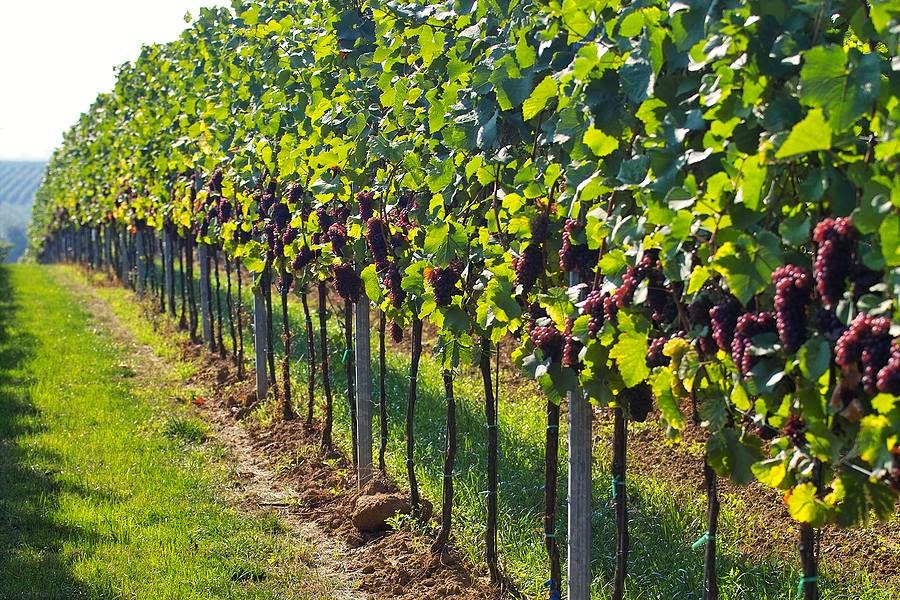
What’s eating France’s grapes? Well, perhaps consuming is a better term and the answer is climate change. Last year, an international team of scientists estimated that by 2050, some of the world’s most famous wine-making regions will shrink by nearly 70 percent.
The grape vine is particularly sensitive to climate variability and change, like many crops.
But wine producers place much more importance on quality since temperature and precipitation affects alcohol, acidity, and color.
As the world continues to warm, conditions in some areas will sour.
Signature wines produced in some of the world’s most famous regions, such as Champagne or Bordeaux, will probably lose some of their quality and character.
As the heat rises, so does the resulting wine’s alcohol content.
A warmer growing season or longer hang time on the vine produces more sugar in the grapes.
The cool conditions of the Champagne region produce low-sugar, high acid grapes that are well suited for champagne.
So what does this mean for the lovers of fine French champagne? It means that the best sparkling wines may not come from its namesake region in the future.
“Given that most grapevines produce fruit for 25 to 50 years, grape-growers and wine-makers must consider the long term when determining what to plant, where to plant, and how to manage their vineyards,” says Antonio Busalacchi, climate scientist and wine expert at the University of Maryland.
The wine sector of France is now buying up land in places like southern England as it confronts the need to simultaneously reduce risks of yield losses and continue to produce the world’s leading wines.
In fact, English sparkling wines have recently been beating champagnes at international competitions.
The soil in locations like Dover is similar to the chalky soil of the Champagne region.
This transition for grape growers, specifically the relocation of wine-makers from the Champagne region, raises an interesting question given the restrictions placed on products bearing the Champagne name by the Appellation of Controlled Origin (AOC).
AOC rules dictate that only wines produced under certain conditions in the Champagne region may bear the product name champagne versus sparkling wine.
So what will happen when the climate becomes inhospitable to the grapes used to make champagne and the traditional houses leave the region? This issue is sure to become more hotly debated as temperatures continue to rise in France.
_________________
Grape Expectations
,
Science News
(Jan. 24, 2014, 2:50 PM),
https://www.sciencenews.org/article/grape-expectations?mode=magazine&context=187953
.
Lisa Palmer,
Vineyards Take Action as Climate Change Threatens Wine and Livelihood
,
The Guardian
(Oct. 3, 2013, 12:42 PM),
http://www.theguardian.com/sustainable-business/blog/vineyards-climate-change-threat
.
Id.
Gaidso,
supra
note 1.
Id.
Id.
Id.
Id.
Id.
Palmer,
supra
note 2.
Id.
Georgi Kanchev,
British Wine Benefits as the Climate Changes
,
N.Y. Times
, Dec. 14, 2013, at B1
available at
.\.
Palmer,
supra
note 2.
Comité Champagne,
Recognition of the Champagne Appellation
,
http://www.champagne.fr/en/terroir-appellation/appellation/recognition-of-the-champagne-appellation
(last visited Mar. 17, 2014).
Id.
You Can't Sit With Us! The Different Permitting Standards for LNG for Countries with and without U.S. Free Trade Agreements
By: Ellen Black, Production Editor
Until recently, domestic production of natural gas was so low that the United States imported it in the form of liquefied natural gas (LNG) to LNG terminals built on the coasts.
However, with the “shale-gas revolution made possible by fracking” and other drilling advances, natural gas is now much more accessible and domestically abundant.
Since natural gas cannot be stored like oil or coal, the glut of this resource must either be used or not drilled until it can be used or sold. This increase in supply, coupled with a constant demand, has resulted in a significant drop in the price of domestic natural gas, creating an artificially low price due to oversupply.
Reasonably, natural gas companies want to increase demand by exporting LNG to countries without this resource, which will pay a much higher price,
yet the current permitting requirements limit exportation.
The Natural Gas Act of 1938 (NGA), 15 U.S.C. § 717,
governs the regulation of natural gas, and contains provision § 717b(a), which governs the exportation and importation of LNG using a standard of “benefiting the public good.” For the first time in decades, in May 2013, two permits to export LNG were conditionally granted, one in Louisiana and one in Texas.
This represents a significant shift in this industry, and has opened the door to at least twenty other such applications to the Department of Energy (DOE).
Originally, all applications for import and export of natural gas underwent the same process of review as analyzed under a public interest standard.
However, as America promulgated more complex free trade agreements in recent years, it has become practice to subject applications for import and export to different standards of review for those countries with and without free trade agreements.
In the Energy Policy Act of 1992
, Congress amended the NGA to include sections 3(a) and 3(c) which govern differences in free trade agreement and non-free trade agreement country applications for export of natural gas. The Economic Regulatory Administration (ERA) is responsible for making the decision whether an application for export is “consistent with the public interest,” which is based on “various factors including security of supply, balance of payments, price of the import or export, national and regional needs for gas, and the eligibility of the purchasers and participants.”
For export permits to free trade agreement countries, with the Energy Policy Act of 1992, there is now an “expedited application process.”
This section also requires that these applications be deemed “consistent with the public interest” and that these applications be “granted without modification or delay.”
As a result of the latter provision, the DOE does not conduct a full public interest analysis of these section 3(c) applications and cannot condition them “by insertion of terms which otherwise might be considered necessary or appropriate.”
There are currently twenty countries with which the U.S. has free trade agreements concerning the treatment of natural gas.
For non-free trade agreement countries, there is a much more in-depth process as dictated by § 3(a) of the NGA, which provides that “the [Secretary of Energy] shall issue such order upon application, unless after opportunity for hearing, [he] finds that the proposed exportation or importation will not be consistent with the public interest.”
This creates “a rebuttable presumption that a proposed export of natural gas is in the public interest.”
For countries without free trade agreements, the DOE issues a notice of the application for import or export in the Federal Register, publishes the Section 3(a) application and all subsequent pleadings and orders on its website, and invites interested persons to participate in the proceedings.
In granting this application, there is “a wider range of considerations for a permit within the public interest review, includes in part environmental concerns, the domestic need for natural gas, and international considerations.
These “non-statutory” criteria are not exhaustive, and have changed over decades with each subsequent agency application.
This difference in permitting schemes thus creates an unnecessarily complicated and bifurcated process for LNG permits. It is in the best interest of the United States to have more exportation LNG, and also a more streamlined and uniform process for permitting.
_________________
Bryan Walsh, The Unintended Consequences of Exporting Natural Gas, Time (May 27, 2013),
http://science.time.com/2013/05/27/natural-gas/#ixzz2iAT5ebSh
.
Id.
Id.
Id.
15 U.S.C. § 717 (2013).
Zach Colman, DOE Gives Green Light to Controversial Natural Gas Export Project, The Hill E2 Wire (May 17, 2013, 1:30 PM),
.
Id.
Shani Harmon, Reining in the Natural Gas Bonanza, Legally: Whether U.S. Law and Policy Restrictions on Natural Gas Exports Are Consistent with International Trade Law, 25 Geo. Int'l Envtl. L. Rev. at 619 (2013).
Id.
42 U.S.C. § 7172 (2013).
Report of the Committee on Natural Gas Imports and Exports, 1 Energy L.J. 165 (1980).
Harmon, supra note 8, at 619.
DOE's Program Regulating Liquefied Natural Gas Export Applications: Hearing on LNG Before the House Committee on Oversight and Government Reform, Subcommittee on Energy Policy, Health Care, and Entitlements (March 19, 2013) (statement of Christopher Smith, Acting Assistant Secretary for Fossil Energy).
Id.
Id.
Harmon, supra note 8, at 620.
DOE, supra note 13.
Id.
Id.
Id.
Running on Fumes: Is Natural Gas the Solution for America's Car Culture?
| Image Source |
Natural gas has been making quite a buzz lately, between debates about opening up trade of domestic American gas with our allies, sending natural gas to aid Ukraine, and becoming a less energy-dependent nation. However, almost none of the chatter about natural gas has involved using it as a replacement for one of our largest domestic causes of pollution: automobiles.
Let’s face it; America has a thing for cars, and that isn’t going away. Try as we might, Americans can’t seem to give up the independence and freedom of driving our cars.[1] Although new hybrid technology developments such as those in the Toyota Prius and Chevy Volt have helped, the average fuel economy of today’s cars has barely caught up with the 25 mile-per-gallon 1913 Ford Model T[2]. Despite improvements, the fact remains that oil is just not a clean enough source of fuel for our car-crazed culture.
Enter natural gas, the new belle of the clean energy ball. Believe it or not, car engines can be built or converted to run on natural gas in a highly compressed form. Compressed natural gas, or CNG, emits approximately 30% less carbon dioxide when combusted than oil.[3] Moreover, current natural gas prices range from $0.79 to $1.50 per gallon equivalent, which means that driving a CNG-powered car is significantly cheaper than a gas-powered car.[4] Despite these advantages, natural gas powers only 112,000 vehicles in the United States.[5]
Despite its many potential advantages, it doesn’t appear that we’ll be paying $1 per gallon to run our CNG cars anytime soon. Unless the EPA can reduce the costs of compliance with alternative fuel regulations, CNG-powered cars will remain a pipe dream.
[1] Paul Lucas, Number of Cars on U.S. Roads on the Rise, The Green Car Website, (Mar. 9, 2014, 10:00 PM), http://www.thegreencarwebsite.co.uk/blog/index.php/2013/11/05/number-of-cars-on-us-roads-on-the-rise/.
[2] Michael Mulchay, U.S vehicle fuel efficiency has increased only 3 mpg in 80 years, Gizmag.com, (Mar. 9, 2014, 10:00 PM), http://www.gizmag.com/us-vehicle-fuel-efficiency-improves-3mpg-80-years/12410/.
[3] NaturalGas.org, http://naturalgas.org/environment/naturalgas/, (last visited Mar. 9, 2014).
[4] Ben Wojdyla, Should You Convert Your Car to Natural Gas?, PopularMechanics.com, (Mar. 9, 2014, 10:00 PM), http://www.popularmechanics.com/cars/how-to/maintenance/should-you-convert-your-car-to-natural-gas.
[5] Alternative Fuels Data Center, http://www.afdc.energy.gov/vehicles/natural_gas.html, (last visited Mar. 9, 2014).
[6] Environmental Protection Agency, http://www.epa.gov/otaq/consumer/fuels/altfuels/altfuels.htm, (last visited Mar. 9, 2014); 42 U.S.C. § 7522(a)(3).
[7] Wojdyla, supra note 4.