

Horses as Service Animals?

By: Catherine Barrett, Staff Member

On March 15, 2011, the definition of “service animal” under federal regulations changed from “any guide dog, signal dog, or other animal individually trained to do work or perform tasks”[1]to “any dog that is individually trained to do work or perform tasks”[2] (emphases added). The new definition excludes all other species from full legal protection, including miniature horses.

Miniature horses are a new option in the field of assistance animals. Although few are in use in the United States, horses trained to guide the blind provide a valuable alternative when a dog is unsuitable, as in the case of observant Muslims, who view dogs as unclean.[3] Guide horses are trained to perform the same tasks as guide dogs.[4] Horses appeal to those who are allergic to dogs, have a task that requires greater strength and stamina, and those who simply prefer horses.[5]

Miniature horses are the only species other than dogs mentioned in the new regulations.[6]Although horses and their owners do not get the same level of protection, their utility is at least recognized; all other nontraditional species, including trained monkeys and parrots, are excluded from being considered service animals.[7]

It is important to balance the rights of the businesses expected to accommodate service animals. Even if miniature, a horse is much more difficult to accommodate in human spaces than a dog. Horses cannot curl up compactly in vehicles or underneath tables. They require more space[8] and have more difficulty going down stairs than dogs.[9] While the new regulations segregate miniature horses from true “service animals,” public entities are required to make “reasonable modifications in policies, practices, or procedures” to permit their use.[10] When considering whether modifications are “reasonable,” the entity may consider the size of the miniature horse, whether the handler has control over it, whether it is housebroken, and whether the horse’s presence would compromise legitimate safety requirements.[11]

If guide horses are useful enough that they must be accommodated under “reasonable” circumstances, then they should be defined as “service animals.” While the regulations have separately protected their use in public, excluding horses may cause their owners other legal problems in private as landlords and state laws restrict where they may be kept.[12]

It is important to remember that America’s most iconic service animal, the Seeing Eye dog, is less than a hundred years old.[13] It would be naïve to assume that we have explored all the ways in which animals can help people to live fuller lives, and innovation cannot occur unless novel service animals can be used in public areas. Individuals need the freedom to be pioneers. Abuses should be punished,[14] but should not lead to a definition of “service animal” so narrow that it excludes domesticated animals with which humanity has had a long and successful partnership.

The clear solution is to legally define service animals by their training, not by their species. The original definition, emphasizing training to perform tasks, allowed those judging service animals to consider “function, not form.”[15] A broad definition lets each individual choose the service animal best suited to his needs, while still leaving room to protect public health and safety in its application by the courts.[16]

[1] “Service animal means any guide dog, signal dog, or other animal individually trained to do work or perform tasks for the benefit of an individual with a disability, including, but not limited to, guiding individuals with impaired vision, alerting individuals with impaired hearing to intruders or sounds, providing minimal protection or rescue work, pulling a wheelchair, or fetching dropped items.” 28 C.F.R. § 36.104 (1991).

[2] “Service animal means any dog that is individually trained to do work or perform tasks for the benefit of an individual with a disability, including a physical, sensory, psychiatric, intellectual, or other mental disability. Other species of animals, whether wild or domestic, trained or untrained, are not service animals for the purposes of this definition.” 28 C.F.R. § 35.104 (2010)(effective March 15, 2011).

[3] Ben Leubsdorf, Seeing-eye horse guides blind Muslim woman, Health care on MSNBC.com,http://www.msnbc.msn.com/id/30155540/ns/health-health_care/ (last visited Sept. 5, 2011).

[4]Common Misconceptions about Guide Horses, The Guide Horse Foundation,http://www.guidehorse.org/misconceptions.htm (last visited Sept. 5, 2011).

[5]Frequently Asked Guide Horse Foundation Questions, The Guide Horse Foundation,http://www.guidehorse.org/faq_GHF.htm (last visited Sept. 5, 2011).

[6] 28 C.F.R. § 35.136 (2010).

[7] Rebecca Skloot, Creature Comforts, N.Y. Times, December 31, 2008,http://www.nytimes.com/2009/01/04/magazine/04Creatures-t.html?pagewanted=1

[8] Eugenia Firth, The Guide Horse Foundation: Joke or Jeopardy?, The Braille Monitor, April 2001, http://www.nfb.org/Images/nfb/Publications/bm/bm01/bm0104/bm010404.htm

[9] Lyn Jacobs, Get the real facts!, GuideHorseNo.com,http://www.guidehorseno.com/article1.html (last visited Sept. 5, 2011).

[10] 28 C.F.R. § 35.136 (2010)

[11]Id.

[12] Robert L. Adair, Note, Monkeys and Horses and Ferrets… Oh My! Non-Traditional Service Animals Under the ADA, 37 N. Ky. L. Rev. 415 (2010).

[13] The Seeing Eye has been training dogs since 1929. Our Mission & History, The Seeing Eyehttp://www.seeingeye.org/aboutUs/default.aspx?M_ID=88 (last visited Sept. 5, 2011).

[14] The appropriate response to concerns about pets being claimed as “service animals” is to punish fraud, not a species ban. Skloot, supra note vii.

[15]Id.

[16]Id.

Getting Green by Going Green: Should the Federal Government be in the Business of Subsidizing New Energy?

By Kelly Calder, Staff Member

Solyndra, a California solar panel manufacturer, recently shut down operations and expressed its intent to file Chapter 11 Bankruptcy.[1] Described as the “biggest green-tech flameout yet,” Solyndra failed despite receiving over one billion dollars from investors[2] and a 535 million dollar loan from the U.S. Department of Energy’s (“DOE”) “Loan Guarantee Program.”[3]

This is not the first solar energy company to file for bankruptcy; Solyndra joins two other American companies, Spectrawatt Inc. and Evergreen Solar Inc., which filed this past August.[4] Solyndra cited numerous reasons for its failure, including heavy competition from government subsidized Chinese manufacturers, but the primary question raised by observers is “whether [the Federal Government] should even be in the business of subsidizing new renewable energy technologies?”[5]

Solyndra’s loan guarantee was a byproduct of The American Recovery and Reinvestment Act of 2009, which amended the Loan Guarantee Program by adding Section 1705.[6] According to the Department of Energy, this temporary program “authorizes loan guarantees for certain renewable energy systems, electric power transmission systems and leading edge biofuels projects that commence construction no later than September 30, 2011.”[7] There are several criteria for receiving a loan guarantee, and the mission of the DOE’s Loan Programs Office is to “enhance American competitiveness in the global economy of the 21st century.”[8] Solyndra was the first company to receive such a loan,[9] and was considered by many to be its “poster child.”[10] Solyndra’s bankruptcy has been viewed by many as a devastating blow to the program.[11]

Despite the uncertainty engendered by Solyndra’s bankruptcy, some still staunchly defend the loan program.[12] They explain that Solyndra represented less than two percent of the total loan commitments made by the DOE and also that, “with a capitalization of just $4 billion, DOE has committed or closed $37.8 billion in loan guarantees for 36 innovative clean energy projects.”[13] The program’s overall success should not be diminished because of the failure of one of its projects.

The DOE has not allowed Solyndra’s bankruptcy to affect its loan policies. According to its website, the DOE just finalized a partial guarantee for an $852 million loan to fund a California solar power plant dubbed the Genesis Solar Project.[14] In addition, First Solar Inc., which is also funded by the DOE, has been largely successful in its solar paneling manufacturing services.[15] First Solar employs the same “thin film” technique Solyndra did, but has managed to overcome the competitive market and overall decline in solar paneling prices.[16]

Upon examination of all the facts, it is apparent that Solyndra’s financial failure is not evidence of government involvement gone wrong, but rather the product of multiple factors, including the inherent difficulties any startup faces when it fails to adapt quickly to unanticipated changes in the economy. While Solyndra’s bankruptcy has been divisive, it should not be viewed as the death kneel for the DOE’s loan program, or prevent future programs like it.

[1] Todd Woody, What Solyndra’s Bankruptcy Means for Silicon Valley Startups, Forbes (Aug. 31, 2011, 3:07 PM), http://www.forbes.com/sites/toddwoody/2011/08/31/what-solyndras-bankruptcy-means-for-silicon-valley-solar-startups/.

[2]Id.

[3] U.S. Department of Energy Loan Programs Office , https://lpo.energy.gov/?page_id=45 (last visited Sept. 5, 2011).

[4]Solyndra Files Bankruptcy, Federal Loan Guarantee Given in Vain, International Business Times New York (Sept. 1, 2011, 11:54 AM),http://newyork.ibtimes.com/articles/207188/20110901/solyndra-bankruptcy-news-solar-panel-doe-omb.htm.

[5] Woody, supra note 1.

[6] U.S. Department of Energy Loan Programs Office, https://lpo.energy.gov/?page_id=41 (last visited Sept. 5, 2011).

[7]Id.

[8] U.S. Department of Energy Loan Programs Office, https://lpo.energy.gov/?page_id=17 (last visited Sept. 5, 2011).

[9] Andrew Dodson, Solyndra Follows Evergreen Solar, Files for Bankruptcy; Stimulus Questioned, Booth Mid-Michigan (Sept. 2, 2011, 2:20 PM) http://www.mlive.com/business/mid-michigan/index.ssf/2011/09/solyndra_ follows_evergreen_sol.html.

[10] Woody, supra note 1.

[11]Supra, notes 4 and 9.

[12] Devon Swezey, Solyndra's Failure Is No Reason To Abandon Federal Energy Innovation Policy, Forbes (Sept. 2, 2011, 7:33 PM)http://www.forbes.com/sites/energysource/2011/09/02/solyndras-failure-is-no-reason-to-abandon-federal-energy-innovation-policy/.

[13]Id.

[14]DOE Finalizes Partial Guarantee for $852 Million Loan to Support California Concentrating Solar Power Plant, Department of Energy (Aug. 26, 2011),https://lpo.energy.gov/?p=5153.

[15] Swezey, supra note 12.

[16]Id.

Paradise in a Cup of Coffee?

by Chad Riney, Staff Member

“Over the last decade, the Kona Coffee belt, a 20-mile strip of plantations along [Hawaii’s] west coast, has become the Napa Valley for coffee devotees, complete with farm tours and tastings.” Maura Egan,

Naughty by Nature

, N.Y. Times Style Magazine, March 26, 2010, http://www.nytimes.com/2010/03/28/t-magazine/28well-hawaii.html?_r=1&pagewanted=1. It is no surprise that Hawaii has regulated this valuable industry in an attempt to protect it. Hawaiian law requires that the packaging of locally grown coffee indicate both where in Hawai’i the coffee was grown and the percentage by weight of the contents of Hawaiian coffee. HRS §486-120.6. In addition, it is unlawful to label a Hawaiian region as a source of the product when the percent by weight is less than ten percent.

Id.

The laws attempt to protect and preserve the industry’s reputation. The labeling requirement is essentially a disclosure requirement; consumers will know how much Hawaiian coffee they are getting and from where it comes. The baseline requirement, ten percent, for labeling the coffee as a blend prevents dishonest coffee producers from claiming their product to be Hawaiian. But the question is whether these requirements are actually effective in preserving the prestige of Hawaiian coffee.

The Kona Coffee Famers Association makes a pretty strong argument that these laws do not effectively meet their goals. They claim that the labeling laws are used deceptively for promoting coffee by including the minimal amount of Kona coffee.

See

Kona Coffee Facts

, Kona Coffee Farmers Association, http://www.konacoffeefarmers.org/Kona_Coffee_Facts.asp (last visited Jan. 26, 2011). The Association is not opposed to the blending of coffee, they are concerned foreign coffee producers can use the Kona name to market their lower grade coffee.

See id

.

The institution of labeling requirements is undeniably a step in the right direction towards nourishing the Hawaiian coffee industry. However, changes must be made in order to prevent low-grade coffee producers from entering the market on Kona’s coattails.

KJEANRL named Top 100 Law Journal

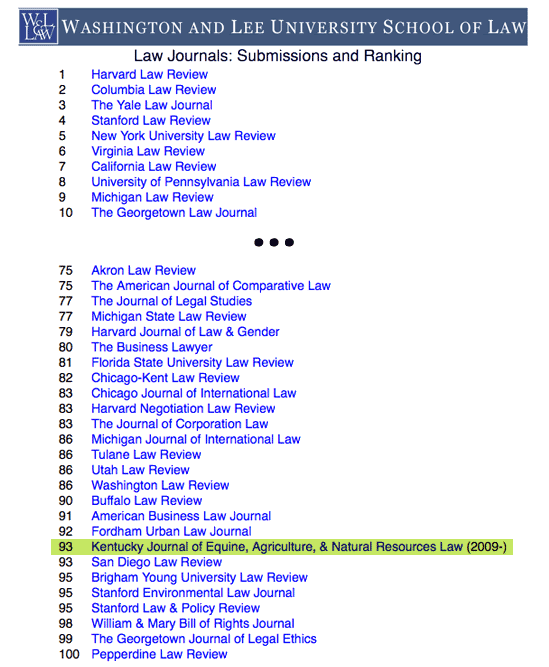
Washington & Lee University School of Law has named the Kentucky Journal of Equine, Agriculture, & Natural Resources Law as one of the Top 100 Law Journals of 2010.

KJEANRL named Top 100 Law Journal

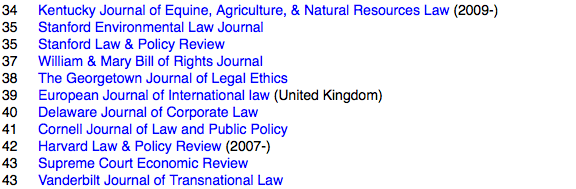
Among "Specialized Journals," the KJEANRL came it at #34, and ahead of some very reputable competitors.

KJEARNL #34

Thanks to all of our staff and editors for their hard work and contributions that made this accomplishment possible. To view the full rankings, please visit Washington & Lee University School of Law, Law Journal Rankings, select the "2010 Comb." rankings, and click "Submit."

Cooped Up Hens: Cage v. Cage-Free Eggs

by Natasha Farmer, Staff Member

Egg-laying hens used for commercial egg production in the United States have been kept in cramped cages for many years. This has caused many states to start banning restrictive livestock cages and shift the hens to open pens. Seven states have passed laws that will eventually ban or limit the different types of livestock cages.

Chicken Rules have Unintended Consequences

,

Drovers

, April 26, 2010,

available at

http://www.drovers.com/news_editorial.asp?pgID=675&ed_id=7240

.

However, open pens have resulted in many unintended consequences. After decades of breeding, hen’s territorial instincts have been boosted, which has made the hens more prone to pecking attacks “so fierce they are often called cannibalism.”

Id.

Ian Duncan, a professor emeritus of animal welfare at University of Guelph in Guelph, Ontario, stated that cannibalism is a learned behavior, which is passed from one territorial hen to another.

Id

. Experts have warned that this behavior will increase if hens are moved from small cages with five to ten birds to open pens that can hold dozens.

Id

.

The Coalition for Sustainable Egg Supply (“CSES”) leads a cooperative effort toward understanding egg supply, and boasts large and diverse constituent members including Bob Evans Farms Inc., McDonald’s Corp., and United Egg Producers. Rod Smith,

Group Begins Hen Housing Study

,

Feedstuffs

, April 9, 2010,

available at

http://www.feedstuffsfoodlink.com

. One of the primary objects of CSES concern is to evaluate the extent that different housing systems for egg-laying hens can provide both “hen well-being and egg supply that is affordable and sustainable.”

Id

. The Coalition’s mission is to evaluate the sustainability impact of three different types of egg laying systems: cage-free aviary housing systems, enriched housing including perches and nests, and caged housing environments. Coalition for Sustainable Egg Supply,

http://www.sustainableeggcoalition.org/prod/

(last visited Jan. 28, 2010). The project has yet to yield published results.

Id

.

There seems to be no right answer in this ongoing matter. It is inhumane to keep hens in such close quarters. However, if you allow the hens to roam freely in open pens serious injury could occur. Hopefully, the CSES will discover the best solution through ongoing research, but the answer may not come soon enough.

Hack Job: Security breach causes the European Commission to halt carbon trading

by Whitney Waters, Staff Member

Last month the European Commission shut down Europe’s carbon trading market after computer hackers exposed a glitch in the Emissions Trading System. James Kanter,

E.U. Closes Emissions Trading System After Thefts

, N.Y. TIMES, (Jan. 19, 2011),

available at

http://www.nytimes.com/2011/01/20/business/global/20iht-carbon20.html.

According to Bloomberg, the hackers stole approximately 2 million permits worth €29.5 million, or $41.1 million, in carbon allowances from the system. Ewa Krukowska and Mathew Carr,

Carbon Permit Trading Halt Entering Second Week; EU Registers Still Closed

, BLOOMBERG, (Jan. 26, 2011), http://www.bloomber.com/news/2011-01-26/carbon-permit-trading-entering-second-week-eu-registers-still-closed.html. The countries involved in the hacking scheme were Austria, Greece, the Czech Republic, Poland and Estonia, with the permits from the Czech Republic registry worth €7 million, or $9.3 million, alone.

Id

.

The European Commission initially stated the Emissions Trading System (hereinafter, “ETS”) would re-open on Jan. 26, however, this has been pushed back because of the continuing investigation by the European Commission, and until all the European Union (hereinafter, “EU”) member states involved in the carbon trading market can show they have adequate security measures in place.

See

James Kanter,

E.U. Closes Emissions Trading System After Thefts

, N.Y. TIMES, (Jan. 19, 2011),

available at

http://www.nytimes.com/2011/01/20/business/global/20iht-carbon20.html.

The European Commission regulates the carbon trading market, which is the largest emissions market in the world.

Id.

The EU ETS is based on the “cap and trade” principle. European Commission Climate Action,

Emissions Trading System (EU ETS)

,

available at

http://ec.europa.eu/clima/policies/ets/index_en.htm (last visited Jan. 26, 2011). Despite the on-going security problems with the system, the “cap and trade” principle is a beneficial way to combat and lower greenhouse gas emissions. Under this principle, there is a limit, a “cap,” on the amount of gases that can be released by each member country.

Id.

Currently, the companies in these countries are allotted a certain amount of greenhouse gases, which is shown in their permits.

Id

. The amount of gas allowed is determined by each individual EU member state; however, this amount will change in 2013 when the EU will set the limit on greenhouse gas emission for each state.

Id

. The companies are allowed to trade the permits with other companies for profit to fit their needs depending on the amount of gasses they will release.

Id

. At any given years end, the companies must show permits to cover every tonne of greenhouse gas they emit, or face significant fines. European Commission Climate Action,

Emissions Trading System (EU ETS), available at

http://ec.europa.eu/clima/policies/ets/index_en.htm (last visited Jan. 26, 2011).

Overall, this trading system encourages companies to decrease their amount of greenhouse gas because if they exceed their limit, they must buy highly priced permits from other countries. The system already has shown to be viable because by 2020, it is projected that the amount of gas released will be 21% lower than in 2005.

Id

. With increased security measures to prevent fraud and cyber attacks, other countries should consider the beneficial nature of the “cap and trade” system for the environment, and the potential to reduce the world’s total greenhouse gas emissions.