
Blog by: Conner Jackson
In 2018, the United States imposed federal tariffs on steel and aluminum under Section 232 of the Trade Expansion Act, prompting retaliatory action by the European Union (EU) against American whiskey exports. [i] The dispute led to a twenty percent decline in whiskey exports to the EU and a larger forty-two percent drop in exports to the United Kingdom.[ii] The EU later suspended the whiskey tariffs imposed in 2018 through 2022, but American whiskey again faces uncertainty within the industry.[iii] In early 2025, the EU threatened a fifty percent tariff on whiskey imports from the U.S., followed by a recently renewed threat of thirty percent in January of 2026.[iv]
Jim Beam, one of Kentucky’s prominent bourbon distilleries, announced a temporary pause in production at their main distillery, citing a recent decline in earnings amid a “challenging economic environment.”[v] However, bourbon is not the only affected industry.[vi] Bourbon distilleries are a major demand source for Kentucky corn and wheat.[vii] When bourbon exports slow, the reduced demand has a downstream effect on Kentucky farm producers.[viii] Kentucky farmers have no influence to address federal tariff policy directly and currently lack any state level tool to embrace the effects of federal trade actions.[ix] Despite this, Kentucky should lawfully respond to the economic harm retaliatory tariffs impose on its farmers by adopting a compensation program based on previous state legislation and current statutory frameworks.
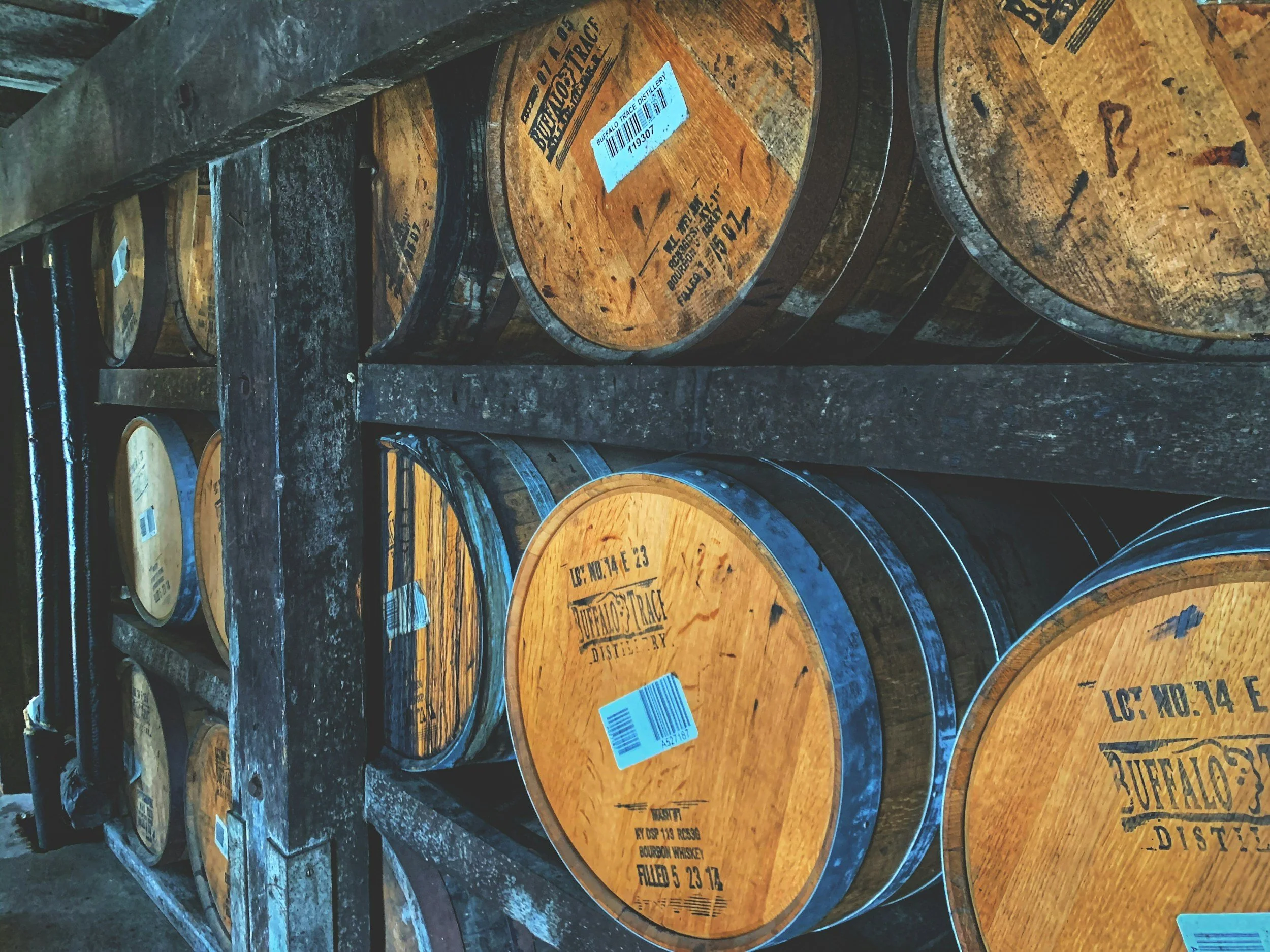
Kentucky bourbon production is deeply dependent on agriculture, especially corn.[x] By law, bourbon must be made from a mash bill—or recipe—containing at least fifty-one percent corn.[xi] The bourbon industry uses more than twenty-one million bushels of corn per year, with an overwhelming majority coming from Kentucky farmers alone.[xii] Beyond tourism, the distiller-farmer relationship forms a core component of Kentucky’s rural economy.[xiii] When Kentucky farmers are integrated into a market involved in international trade, disruption in the bourbon industry impacts Kentucky agriculture.[xiv]
Kentucky cannot address retaliatory tariffs directly.[xv] Authority over international trade policy is exclusively federal.[xvi] Further, under the preemption doctrine, state laws that undermine federal policy objectives or attempt to influence foreign commerce directly are held invalid.[xvii] The Commonwealth could, however, still lawfully respond to the effects of federal tariffs.

In the early 2000s, Kentucky responded to a policy-induced reduction in demand within the local tobacco industry.[xviii] As federal tobacco quotas declined and market volatility increased, tobacco farmers faced economic pressures out of their control.[xix] The disruptions followed the 1998 Master Settlement Agreement, a nationwide settlement between major tobacco manufactures and most U.S. states, including Kentucky, resolving state lawsuits over smoking-related healthcare costs.[xx] The agreement required tobacco manufactures to make annual payments to the settling states and imposed strict marketing restrictions.[xxi] Kentucky responded by establishing the Kentucky Agricultural Development Fund (KADF), which allocated the manufacturers’ payments to diversification grants and helped Kentucky farmers shift away from tobacco dependence.[xxii] This ultimately reflects a previous solution by the state of responding to policy-induced demand shocks that could be the basis for similar state action today.
Further, Kentucky’s Grain Insurance Fund (GIF), codified in KRS Chapter 251, authorizes the State Board of Agriculture to compensate in-state grain producers for harm that is externally caused.[xxiii] Under GIF, farmers deliver grain to licensed buyers with expectation of payment, but when insolvent buyers cannot pay, the farmer suffers a loss through no fault of their own.[xxiv] The state responds only after the documented loss occurs by compensating the farmer.[xxv]
In the bourbon context, distilleries are not insolvent. The harm to farmers does not arise from nonpayment, but from decreased demand from distilleries in purchasing crops attributable to retaliatory tariffs.[xxvi] Although GIF does not respond to market demand changes, it provides a useful legal framework for state action.[xxvii] The state waits until nonpayment or a “harm” has occurred, identifies an external cause beyond the farmer’s control, requires documentation of loss, then compensates that loss without attempting to regulate market behavior.[xxviii] A similar four-step legal framework should be enacted for the agricultural harm in Kentucky’s bourbon industry. Furthermore, Kentucky’s response to the collapse of the tobacco market through the KADF shows a previous solution that state funds can be used to respond to a policy-driven reduction in demand.[xxix] Together, these frameworks demonstrate that Kentucky has both a codified legal mechanism and an established policy practice for compensating agricultural losses caused by external forces.
The compensation program would be based on documented revenue losses suffered by Kentucky agricultural producers attributable to trade retaliation, without conditioning benefits on in-state purchasing or requiring future transactions with in-state distillers.[xxx] This loss-based framework responds only after the harm has occurred and ties compensation to a documented loss due to an external cause beyond the farmer’s control. Kentucky will not be able to change federal trade policy, but the General Assembly can and should act now to protect its rural economy. In doing so, the state can protect its farmers and rural community that form the foundation of the bourbon industry.
[i] U.S.-EU-UK Tariffs on Distilled Spirits and Wines: Timeline and Impact, The Distilled Spirits Council of the U.S. (Feb. 2022), https://www.distilledspirits.org/wp-content/uploads/2022/03/US-EU-UK-Tariffs-Timeline-Toasts-Not-Tariffs-Coalition-2.24.22.pdf [https://perma.cc/K9RR-RA9E]; See generally Trade Expansion Act of 1962 § 232, 19 U.S.C. § 1862.
[ii] The Distilled Spirits Council of the U.S., supra note 1; Kim Mackrael & Benjamin Katz, The $100 Billion of U.S. Goods at Risk in Trump’s Greenland Push, Wall St. (Jan. 20, 2026), https://www.wsj.com/business/the-100-billion-of-u-s-goods-at-risk-of-tariffs-in-trumps-greenland-push-d7fbda31?gaa_at=eafs&gaa_n=AWEtsqckekzYUlXfhOUIVODXFCNCvyokv6IImAiY1XupBa4TVddeYvRuhlH8uI6T8tI=&gaa_ts=69712a01&gaa_sig=-uEJi1UhiaMqkSD4qBkDLXedmhc--HQkAOCJ8glmD5dIco-bw2-cBB1loNmfF_-NYfnZcu3KNYHE0THcNchXkA== [https://perma.cc/K2CB-Y9YJ].
[iii] Andrew Muhammad, American Whiskey Gets Extended Tariff Reprieve in the EU…Just Weeks Before the Deadline, Southern Ag Today (Dec. 28, 2023), https://southernagtoday.org/2023/12/28/american-whiskey-gets-extended-tariff-reprieve-in-the-eujust-weeks-before-the-deadline/ [https://perma.cc/7RPG-FZ5U].
[iv] Mackrael & Katz, supra note 2; Editorial Board, A Tariff Mash for Kentucky Whiskey, Wall St. J. (Dec. 26, 2025), https://www.wsj.com/opinion/jim-beam-kentucky-whiskey-tariffs-trade-distillers-donald-trump-98dc47cb?gaa_at=eafs&gaa_n=AWEtsqcOMdsyf98n8Ti00rAv90fx97SomyR0jqPvM6Yi9A9TMM5D40Ek9-FvHqdoX10%3D&gaa_ts=697a988e&gaa_sig=qR9_X5mK-ADt4qVj6jTnN-RwdxpcDmupzya_CRmNec3302zEZYU8taDzABGCu7oT7GZgJrmk_ayiaEU-alg5bg%3D%3D [https://perma.cc/6ZEF-BCZH].
[v] Editorial Board, supra note 4.
[vi] Kentucky Bourbon as an Agricultural and Economic Engine, Ky. Food & Farm, https://www.kyfoodandfarm.info/features/kentucky-bourbon-as-an-agricultural-and-economic-engine (last visited Jan. 28, 2026) [https://perma.cc/UG27-76LE].
[vii] Id.
[viii] Grant Gardner & Tyler Mark, Could Bourbon Help Kentucky Producers Survive Another Tradewar?, Univ. of Ky. Dep’t of Agric. Econ., Martin-Gatton Coll. of Agric., Food & Env’t (May 30, 2025), https://agecon.mgcafe.uky.edu/could-bourbon-help-kentucky-producers-survive-another-tradewar [https://perma.cc/9F8H-G3Z4].
[ix] See U.S. Const. art. I, § 8, cl. 3.
[x] The Bourbon Effect, Kentucky’s Greatest Asset, Ky. Distillers’ Ass’n, https://kybourbon.com/industry/impact/ (last visited Jan. 29, 2025) [https://perma.cc/2GPH-TA5Y].
[xi] 27 C.F.R. § 5.143 (2025).
[xii] Ky. Distillers’ Ass’n, supra note 10.
[xiii] Ky. Food & Farm, supra note 6.
[xiv] Gardener & Mark, supra note 8.
[xv] See U.S. Const. art. I, § 8, cl. 3.
[xvi] Id.
[xvii] See U.S. Const. art. VI, cl. 2; Crosby v. Nat’l Foreign Trade Council, 530 U.S. 363, 373–74, 388 (2000).
[xviii] Kentucky Tobacco, Still a Tradition for Growers, Ky. Farm Bur. (Sep 5, 2025), https://www.kyfb.com/federation/newsroom/kentucky-tobacco-still-a-tradition-for-growers/#:~:text=%E2%80%9CWe%20did%20have%20a%20system,the%20decline%20in%20tobacco%20production [https://perma.cc/777W-B45E].
[xix] Id.
[xx] Tobacco Master Settlement Agreement, Ky. Office of the Att’y Gen., https://www.ag.ky.gov/about/Office-Divisions/OCEL/Pages/Tobacco-Master-Settlement-Agreement.aspx (last visited Jan 29, 2025) [https://perma.cc/4PS5-4DMF].
[xxi] Master Settlement Agreement, Tobacco Control Laws https://www.tobaccocontrollaws.org/litigation/decisions/master-settlement-agreement [https://perma.cc/C8L8-FW8Y]
[xxii] H.B. 611, 2000 Gen. Assemb., Reg. Sess. (Ky. 2000), ch. 530, §§ 1–2; Ky. Farm Bur., supra note 18.
[xxiii] Ky. Dep’t of Agric., Grain Insurance Fund Protects Kentucky Producers (Mar. 24, 2016), https://www.kyagr.com/Kentucky-AGNEWS/press-releases/Grain-Insurance-Fund-protects-Kentucky-producers.html [https://perma.cc/HH8H-PRWT]; See also Ky. Rev. Stat. Ann. § 251.340 (West 2025).
[xxiv]Ky. Dep’t of Agric., supra note 23.
[xxv] Id.
[xxvi] Gardner & Mark, supra note 8.
[xxvii] See Ky. Dep’t of Agric., supra note 23.
[xxviii] Id.
[xxix] Ky. Office of the Att’y Gen., supra note 20.
[xxx] Cf. C & A Carbone, Inc. v. Town of Clarkstown, N.Y., 511 U.S. 383, 390-92 (1994) (invalidating a local law requiring all waste to be processed at an in-state facility, therefore burdening interstate commerce by favoring in-state economic interests).